

Tooele, UT · What we treat
Neck pain and headaches in Tooele.
One of the most common things we see, and one of the most misunderstood: a cause-first evaluation finds why your neck is loading the way it is, and why it’s started showing up as a headache, then a plan with an endpoint gets you turning your head, sitting at a screen, and sleeping through the night without negotiating with it first.
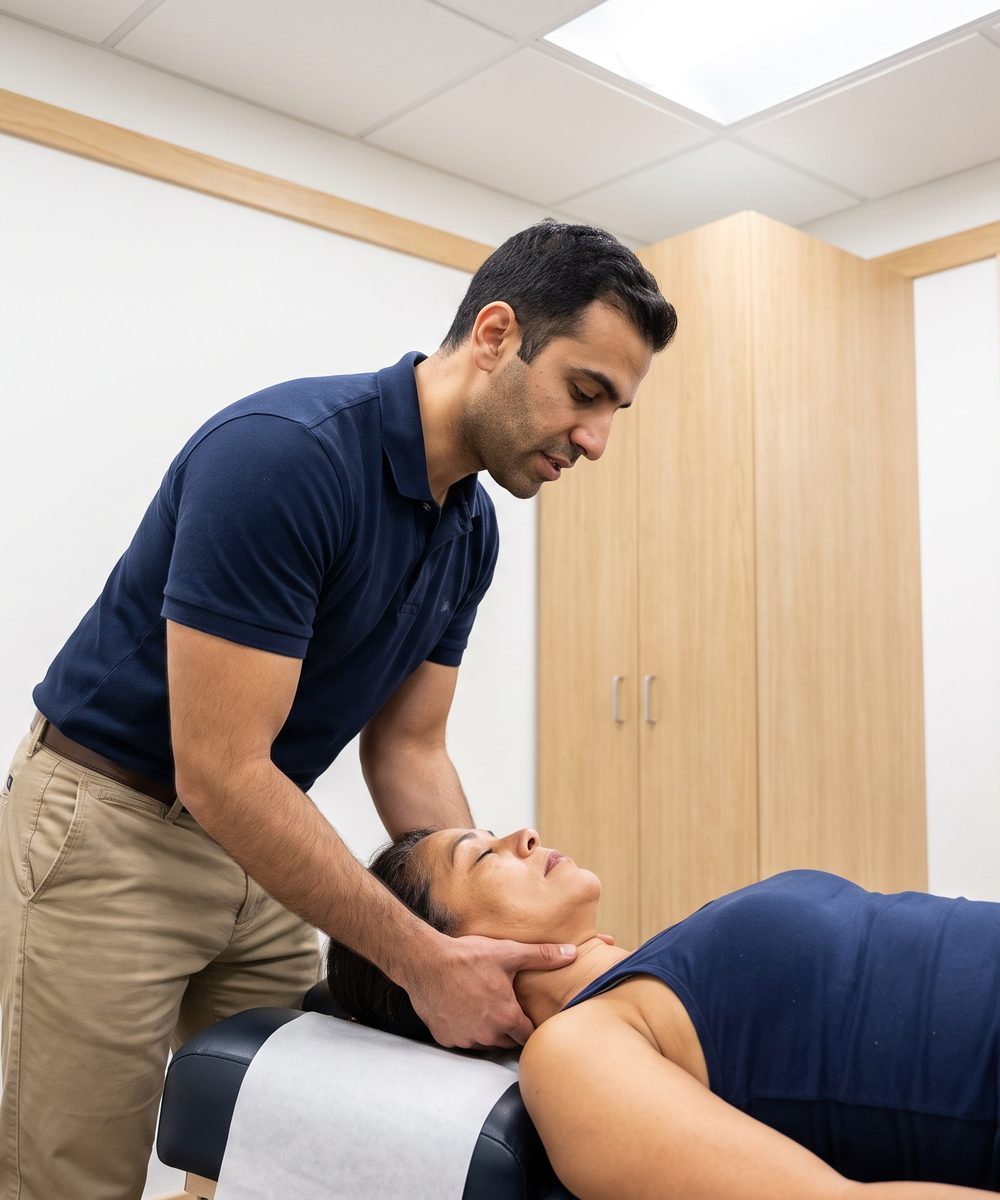
You’ve probably said one of these.
Nobody walks in describing a cervicogenic headache. They describe days like these. Tap one that sounds like your week.
-
UsuallyA stiffness pattern in the joints and muscles on one side of the neck, the kind that limits rotation before it ever becomes painful to sit still.
See how physical therapy restores rotation ⟶ -
OftenA cervicogenic headache, referred up from the joints at the top of the neck rather than starting inside the head itself.
See how dry needling and manual therapy target it ⟶ -
UsuallyPostural strain compounding through the day, the neck holding a forward position it wasn’t built to hold for hours.
See how physical therapy retrains the posture ⟶
- “I’ve started reading traffic signs before I turn my head, not after.”
- “I sleep on my back now. Side sleeping wakes me up by 3am.”
- “A hot shower buys me maybe an hour before it tightens back up.”
If two or three of those sound like your week, you’re not describing a mystery. You’re describing a pattern we see often, and one an evaluation is built to explain.
Why do neck pain and headaches happen?
There’s rarely one single cause, which is exactly why guessing doesn’t work. What we usually find, alone or in combination:
- Cervicogenic headache. Often referred from the joints and muscles at the top of the neck rather than starting inside the head itself.
- Whiplash or an old trauma. A jolt, a fender bender, a fall, that strained the neck’s ligaments and joints beyond what full healing addressed at the time.
- Postural strain. Hours of a forward-head position, over a screen or a phone, that the neck was never built to hold all day.
- Trigger points and guarding. Muscles at the base of the skull and shoulders tightening in a protective pattern that can refer pain upward.
- Cervical disc or joint irritation. A disc or facet joint that’s inflamed enough to limit motion and, sometimes, refer pain into the shoulder or arm.
None of these are diagnoses you make yourself, and most don’t require imaging to start treating. That’s what the evaluation sorts out.
How do we treat neck pain and headaches in Tooele?
Treatment starts with a cause-first evaluation: testing how your neck, upper back, and shoulders move and load together, because where the headache lands isn’t always where the problem started. From there, care moves through four named phases.
The plan’s endpoint is named at your evaluation, reviewed with you every phase, because the goal is to get you back to your week, not to keep you on the schedule.
Calm it down.
Hands-on manual therapy and gentle positions that unload the irritated joints, starting the first visit. Headaches usually ease within the first few sessions.
Restore what’s stuck.
Mobility work for the neck and upper-back segments actually restricting rotation, dosed to what your neck can tolerate that week.
Build strength you trust.
Progressive neck and shoulder-blade strength against standards you clear before moving on, so looking over your shoulder stops requiring your whole torso.
Make it stay fixed.
Testing before you’re cleared, then a home program sized to your desk and driving habits, plus coaching on the screen height, pillow, and posture that tend to reload the same spot.
What does getting better look like?
People who end up booking an evaluation for neck pain and headaches are rarely the ones who threw it out in a single bad turn. More often, it’s a slower story: months of avoiding the aisle that means looking over one shoulder, deciding it’s just how necks work past a certain age. If that’s closer to your version, you’re the typical patient here, not an outlier.
Most patients notice a difference within the first two or three visits, since hands-on treatment starts at the evaluation itself. Progress tends to show up in ordinary places first: checking the blind spot without turning the whole body, making it through a workday without reaching for anything, sleeping through the night on either side. Left untreated, the cause rarely stays quiet; it tends to change how you sit, drive, and sleep, and each headache tends to run a little longer than the last.
An evaluation turns that guesswork into a plan with a specific estimate, reviewed with you at every phase.
Which services treat neck pain and headaches?
Physical Therapy
The foundation of treatment: the cause-first evaluation and the four-phase plan that runs the whole recovery.
02Dry Needling
Targets the trigger points at the base of the skull and upper traps that often refer the headache forward.
03Cupping
Eases the upper trap and neck guarding that keeps the headache camped behind one eye.
04ASTYM
Treats the chronic fibrotic tissue in the upper traps and neck that manual therapy alone hasn’t fully released.
“I’d stopped mentioning the headaches to anyone, I just built my day around them. The evaluation found it was coming from my neck, not my eyes like I’d assumed, and the plan actually had an end date.”Melissa K. · Google review (demo quote, pending client swap)
Questions, answered plainly.
The things people ask on the phone about their neck and headaches, written down.
Sometimes. A cervicogenic headache is referred from the joints and muscles at the top of the neck, often showing up on one side, behind an eye, or at the base of the skull. Migraines and sinus headaches can feel similar, which is why the evaluation tests your neck’s movement and tenderness directly instead of guessing. If anything looks like it needs a physician first, we’ll say so.
A tension headache is usually a diffuse, band-like ache not tied to neck movement, while a cervicogenic headache tends to start at the neck and radiate up, often worsening after a long stretch at a desk. They can overlap, which is why the evaluation checks how your neck moves rather than treating the headache in isolation.
Usually, yes, with modifications from your doctor at the evaluation. Most plans work around your job rather than pausing it: screen height, break frequency, and posture get adjusted for a phase, then loosened once you’ve cleared it. Guidance is specific to your setup, not a blanket “look away from the screen” instruction.
Avoid pushing through sharp or radiating pain, aggressive neck stretching, and long stretches looking down at a phone without a break. Beyond that, avoidance is rarely the fix: most people do better learning which positions are safe than by holding the neck still and waiting. Your evaluation will tell you exactly what to modify.
Start with a cause-first evaluation for your neck and headaches.
Put it in writing.
Five short questions. A real person calls you back, usually within two business hours, with times that fit your week.
The people who end up filling this out are rarely in the worst pain of their life. They’re just done working around it, done picking the errand that doesn’t require the stairs. If that’s the stage you’re at, this is the part where you stop researching and start.
Consider it filed.
A real person will call you back, usually within two business hours, with appointment times that fit your week. Keep your phone nearby.
Can’t wait? Call (801) 508-4784 ⟶Two clinics in Tooele. Both easy to park.
Two locations in town, both with parking by the door. Same team, same one-on-one care. Come see either one before you commit, if you like.
Two clinics · Reach Physical Therapy and Performance
Lodestone Way ⟶West 60 South ⟶Directions open in Google Maps