

Tooele, UT · Services
Physical therapy in Tooele.
One-on-one care with a Doctor of Physical Therapy: a cause-first evaluation, hands-on treatment starting at visit one, and a plan with an endpoint you agree to before you start.

What is physical therapy in Tooele?
Physical therapy here starts with a question most clinics skip: why does this hurt, not just where. Your first visit is a cause-first evaluation, a full hour spent testing movement, strength, and the joints above and below the one that’s loud, so the plan treats the actual reason instead of renting relief from the symptom.
From there, every visit is one-on-one with a Doctor of Physical Therapy, the same doctor, hands-on, for the full hour. Care moves through four named phases, Pain, Prime, Perform, and Prevent, in that order, each with its own job and its own criteria for moving to the next one. You always know which phase you’re in and what earns you the next.
And the plan has an endpoint. It’s named out loud at your evaluation, before you agree to anything, because the goal is to finish the work, not to see you indefinitely.
Calm it down.
Hands-on treatment begins at the first visit. You leave understanding what’s actually going on, and you feel a difference early.
Restore what’s stuck.
Targeted mobility work for the joints and tissue actually holding you back, dosed to your body, not a printed sheet.
Build strength you trust.
Progressive load against standards you have to clear before moving on. Confidence, here, is a training effect.
Make it stay fixed.
Testing before you’re cleared, then a keep-it-gone program sized to your real week. Then we graduate you.
What conditions does physical therapy treat?
Physical therapy is the foundation every other service here is built on, which means it touches most of what walks through the door. A sample of what it commonly addresses:
Neck pain & headaches ⟶
The stiff joints and blind-spot limitation that camp behind one eye by afternoon.
02Shoulder pain ⟶
The overhead reach and the top shelf you’ve started avoiding.
03Elbow & wrist pain ⟶
The grip that’s turned opening a jar into a two-person job.
04Low back pain ⟶
The socks-sitting-down habit and the morning that takes ten minutes to loosen.
05Hip pain ⟶
The ache that’s turned crossing your legs into a negotiation.
06Knee pain ⟶
The stairs you now take one at a time.
07Foot & ankle pain ⟶
The first ten steps out of bed, the worst part of the day.
Left untreated, most of what a cause-first evaluation catches doesn’t stay quiet. It changes how you sit, how you lift, how you sleep, and it tends to widen the longer the actual cause goes untreated instead of just the symptom.
What does a physical therapy session look like?
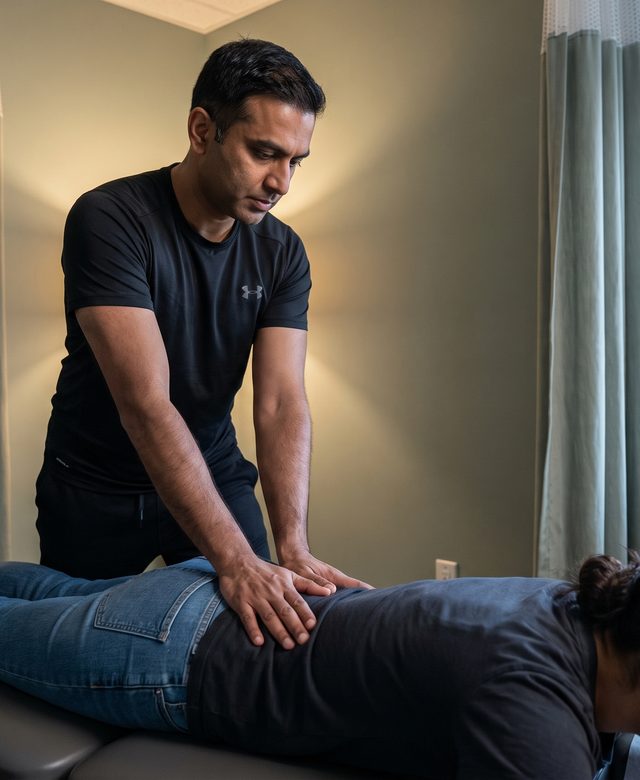
The first visit is the longest and the most important: the evaluation, a conversation about when it started and what it’s costing you, then hands-on testing of movement and strength before any treatment begins. You leave that hour with a plan, not a pamphlet, and treatment has already started.
Every visit after runs the same way: check-in on how the last few days went, hands-on manual therapy where the evaluation pointed, then movement or loading work dosed to where you are in the phase, not to a printed sheet. Your doctor stays in the room the whole time. Before you leave, you know what today’s work was for and what visit two is building toward.
Who this is for, and who it isn’t.
Physical therapy tends to fit people carrying pain that’s overstayed its welcome: something recent that hasn’t settled the way it should, something chronic that’s quietly rearranged your week, or a recovery from surgery or injury that needs a progression, not a guess. You don’t need a referral to start, and you don’t need to already know what’s wrong. That’s what the evaluation is for.
The people who choose one-on-one care over a rotating class or a generic sheet are usually the same type: they want to know why, not just be handed something to do at home. If that describes you, you’re the right patient for this room.
It’s not the right first stop for a medical emergency (chest pain, sudden numbness or weakness, a fracture that needs to be set) or for a diagnosis your evaluation should follow rather than replace. In those cases, call your physician or go to urgent care first, then come see us for the rehabilitation that follows.
Good fit
- Something recent that hasn’t settled the way it should
- Something chronic that’s quietly rearranged your week
- A recovery from surgery or injury that needs a progression, not a guess
- No referral required, and no need to already know what’s wrong
Not the right first stop
- A medical emergency: chest pain, sudden numbness or weakness, a fracture that needs to be set
- A diagnosis your evaluation should follow rather than replace
It’s a tool inside the plan, never the whole plan.
“Two other places told me to stretch and wait. Here they found the actual problem in one visit, told me the plan out loud, and finished it on schedule.”Miguel A. · Google review (demo quote, pending client swap)
Questions, answered plainly.
No. UT allows direct access to physical therapy, which means you can book an evaluation without seeing another provider first. If your insurance requires a referral for reimbursement, we’ll flag that during your free benefits check and help you get one before it holds anything up.
The biggest difference is the hour itself. Here, it’s one-on-one with a Doctor of Physical Therapy for the full visit, not split three ways with a tech running the exercises. The evaluation is cause-first, meaning it looks for the reason behind the pain rather than handing you a generic sheet, and your plan has a named endpoint instead of an open-ended string of visits.
It depends on the cause, not a formula. Your evaluation gives you a specific estimate, and care moves through four phases, Pain, Prime, Perform, and Prevent, each with its own criteria for moving on, so the length of your plan tracks your progress rather than a preset schedule. Most patients notice a difference within the first few visits, because hands-on treatment starts at the evaluation.
Wear clothes you can move in, bring your insurance card if you have one, and bring any imaging or reports you already have, though you don’t need imaging to start. Plan to arrive five minutes early; the evaluation itself, including hands-on treatment, runs about an hour.
Start with a cause-first evaluation.
Put it in writing.
Five short questions. A real person calls you back, usually within two business hours, with times that fit your week.
The people who end up filling this out are rarely in the worst pain of their life. They’re just done working around it, done picking the errand that doesn’t require the stairs. If that’s the stage you’re at, this is the part where you stop researching and start.
Consider it filed.
A real person will call you back, usually within two business hours, with appointment times that fit your week. Keep your phone nearby.
Can’t wait? Call (801) 508-4784 ⟶Two clinics in Tooele. Both easy to park.
Two locations in town, both with parking by the door. Same team, same one-on-one care. Come see either one before you commit, if you like.
Two clinics · Reach Physical Therapy and Performance
Lodestone Way ⟶West 60 South ⟶Directions open in Google Maps