

Tooele, UT · Services
Radial shockwave therapy in Tooele.
A different approach for the tendon or soft-tissue pain that’s outlasted rest, stretching, and exercise: a tool inside a cause-first plan with a Doctor of Physical Therapy, never a stand-alone fix.
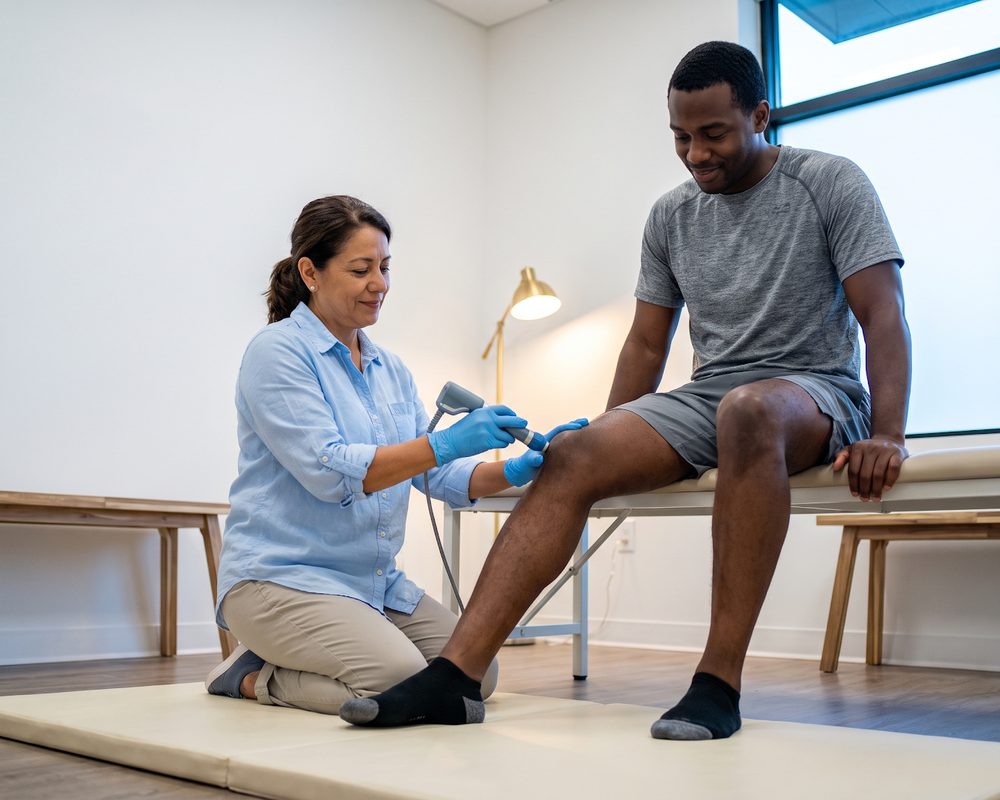
What is radial shockwave therapy?
Radial shockwave therapy uses a handheld device to deliver mechanical pressure waves into the body’s tissue. Unlike focused shockwave, which concentrates its energy at one specific, deeper point, radial shockwave disperses its energy outward from the applicator, which makes it particularly useful for many superficial and moderately deep areas of the musculoskeletal system.
When tissue is repeatedly overloaded or irritated, it can become sensitive and struggle to adapt to the demands you’re placing on it. The mechanical energy from shockwave can influence pain sensitivity and the local tissue environment, and may help support the body’s normal healing and remodeling processes. Reducing pain is only one piece of it, which is why shockwave here is always paired with movement, strengthening, and progressive loading afterward, never used on its own.
Every session is delivered by a Doctor of Physical Therapy, as one tool inside your broader plan, still built around the four named phases: Pain, Prime, Perform, and Prevent.
Calm it down.
Hands-on treatment begins at the first visit. You leave understanding what’s actually going on, and you feel a difference early.
Restore what’s stuck.
Targeted mobility work for the joints and tissue actually holding you back, dosed to your body, not a printed sheet.
Build strength you trust.
Progressive load against standards you have to clear before moving on. Confidence, here, is a training effect.
Make it stay fixed.
Testing before you’re cleared, then a keep-it-gone program sized to your real week. Then we graduate you.
What conditions does shockwave treat?
Radial shockwave tends to get called in for persistent or overuse-related tendon and soft-tissue pain that hasn’t fully resolved with traditional treatment. A sample of what it commonly supports:
Foot & ankle pain ⟶
Achilles tendon pain and plantar heel pain that flares back up the moment training resumes.
02Knee pain ⟶
Patellar tendon pain that keeps its own schedule regardless of how much you rest it.
03Elbow & wrist pain ⟶
Tennis elbow and other elbow tendinopathies that stretching alone hasn’t touched.
04Shoulder pain ⟶
Rotator cuff-related shoulder pain and chronic soft-tissue pain that’s been difficult to fully resolve.
Shockwave isn’t appropriate for every injury. Your symptoms, history, and physical exam at the evaluation determine whether it makes sense as part of your plan, alongside the movement and strengthening work that actually builds the capacity to tolerate training again.
What does a shockwave session look like?
Shockwave is scheduled as part of a regular visit. Your Doctor of Physical Therapy applies the handheld device directly to the treatment area, delivering a rapid tapping or pulsing sensation for a relatively short period. It can be uncomfortable, particularly over a sensitive or irritated spot, but the intensity is adjusted to what you can tolerate.
You can generally return to normal activity afterward, unless your specific condition calls for temporary modifications. As with dry needling, the point isn’t simply to feel better for a few days. It’s to create a better environment for the movement and strengthening work that builds a body able to handle what you actually want to do, whether that’s squatting without pain, running symptom-free, or getting back to CrossFit at the intensity you want.
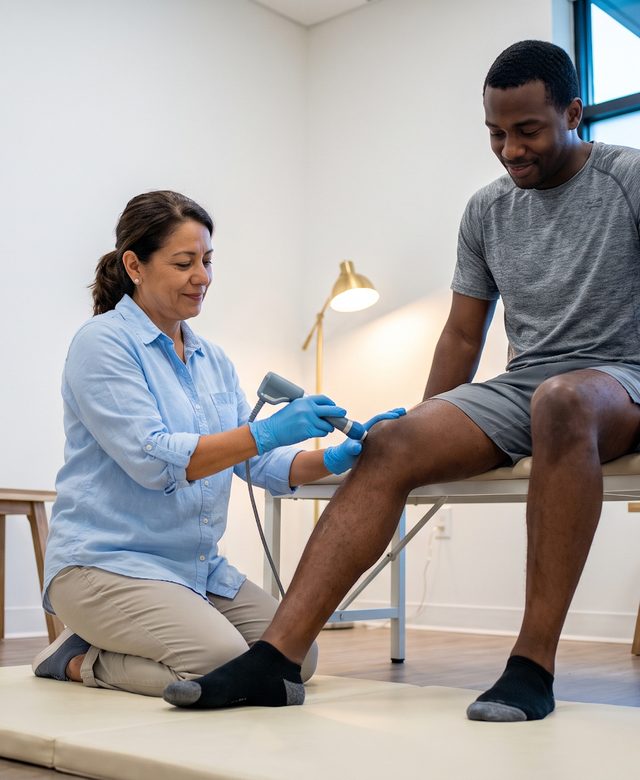
Who this is for, and who it isn’t.
Shockwave tends to fit patients dealing with persistent pain that keeps coming back whenever activity increases: the Achilles that flares every time mileage climbs, the elbow that never quite settled after last season. It’s most useful for tendon and soft-tissue problems that haven’t fully responded to rest, stretching, and general exercise alone.
Shockwave isn’t a magic fix, and it’s not appropriate for every condition. Your evaluation looks at your movement, strength, training demands, and symptoms to determine what’s actually contributing to the problem, and whether shockwave belongs in the plan at all.
Good fit
- Persistent tendon or soft-tissue pain that returns whenever activity increases
- Already tried rest, stretching, and exercise without full resolution
- Willing to pair treatment with progressive loading afterward
- Part of an existing physical therapy plan, not a first appointment
Not the right fit
- Acute fracture or active infection at the treatment site
- Certain blood-clotting disorders or anticoagulant medication
- Pregnancy, over the treatment area (screened at evaluation)
Physical Therapy ⟶
The evaluation and plan it’s built to serve.
02ASTYM ⟶
Another tool for the same stubborn tissue, worked from a different angle.
It’s a tool inside the plan, never a standalone treatment.
“My Achilles had flared up every time I tried to increase mileage for two years. Shockwave paired with the loading program is the first thing that’s actually held.”Demo quote, pending client swap
Questions, answered plainly.
It produces a rapid tapping or pulsing sensation against the treatment area, and it can be uncomfortable, especially over a sensitive or irritated spot. The intensity is adjusted to what you can tolerate. A typical session is short, and you can usually return to normal activity afterward unless your specific condition calls for temporary modifications.
Focused shockwave concentrates its energy at one specific, deeper point. Radial shockwave disperses its energy outward from the applicator instead, which makes it well suited to superficial and moderately deep areas of the musculoskeletal system, the kind of tendon and soft-tissue pain most people bring in.
Here, no. Shockwave is scheduled inside an existing physical therapy plan, as one tool among several, not the treatment itself. Reducing pain is only one piece of it: getting back to lifting, running, or your normal activities still depends on building the strength and capacity to tolerate those demands, which is the job of the rest of the plan.
There isn’t a universal number that works for everyone. It depends on the condition being treated, how long you’ve had it, your current activity level, and how you respond. Rather than prescribing a set number up front, your Doctor of Physical Therapy monitors your symptoms and ability to tolerate loading to decide whether it’s actually helping.
Start with the evaluation that finds what’s actually going on.
Put it in writing.
Five short questions. A real person calls you back, usually within two business hours, with times that fit your week.
The people who end up filling this out are rarely in the worst pain of their life. They’re just done working around it, done picking the errand that doesn’t require the stairs. If that’s the stage you’re at, this is the part where you stop researching and start.
Consider it filed.
A real person will call you back, usually within two business hours, with appointment times that fit your week. Keep your phone nearby.
Can’t wait? Call (801) 508-4784 ⟶Two clinics in Tooele. Both easy to park.
Two locations in town, both with parking by the door. Same team, same one-on-one care. Come see either one before you commit, if you like.
Two clinics · Reach Physical Therapy and Performance
Lodestone Way ⟶West 60 South ⟶Directions open in Google Maps