

Tooele, UT · Services
ASTYM treatment in Tooele.
Instrument-assisted work for scar tissue, fibrosis, and degenerative tendon pain that stretching alone hasn’t moved: a tool inside a cause-first plan with a Doctor of Physical Therapy, never a stand-alone fix.
What is ASTYM treatment?
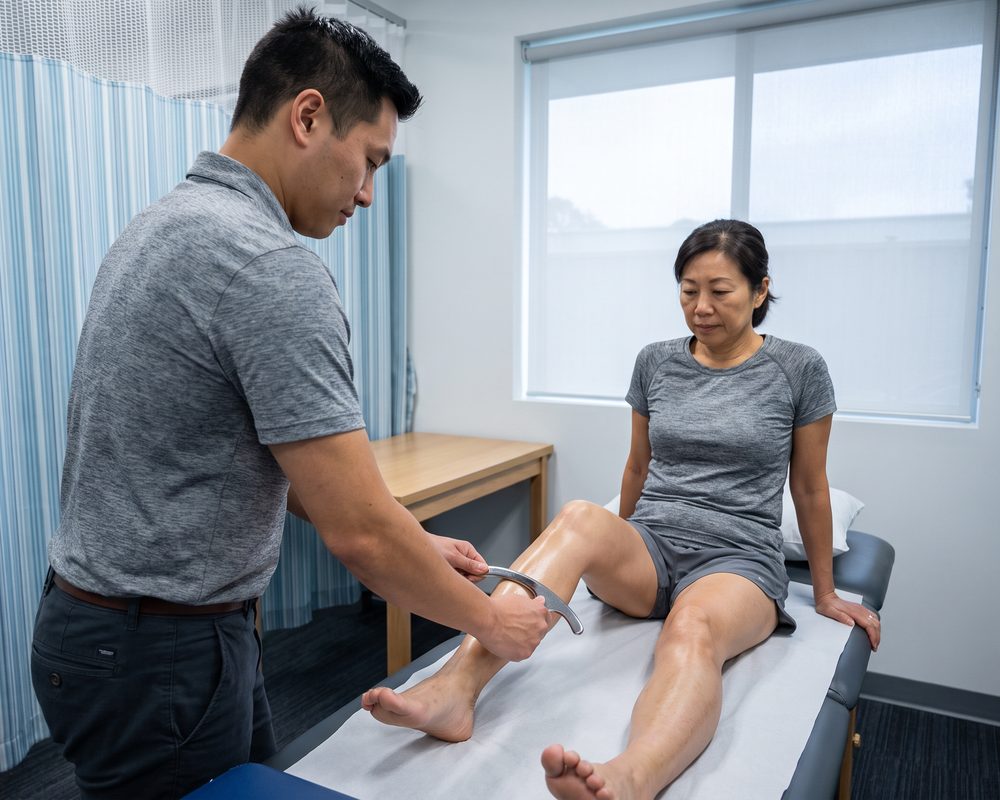
ASTYM uses specially designed resin instruments, run firmly over the skin, to locate and treat scar tissue, fibrosis, and degenerative changes in tendons, muscle, and fascia. The instrument doesn’t just relax a tight muscle the way a hand might. It’s built to find the specific restricted tissue by feel and stimulate the body’s own process for resorbing the unwanted scarring and regenerating healthier tissue in its place.
That’s why ASTYM never stands alone here. It shows up inside a cause-first evaluation and a plan that still runs through the four named phases, Pain, Prime, Perform, and Prevent. It tends to earn its place in Pain and Prime, when chronic or degenerative tissue is blocking the mobility work from taking hold. Once the tissue starts remodeling, the plan moves on to the strength and movement work that keeps it from re-restricting.
Every session is performed by a Doctor of Physical Therapy trained in the technique, as one tool inside your broader plan, not a service you book on repeat instead of doing the rest of the work.
Calm it down.
Hands-on treatment begins at the first visit. You leave understanding what’s actually going on, and you feel a difference early.
Restore what’s stuck.
Targeted mobility work for the joints and tissue actually holding you back, dosed to your body, not a printed sheet.
Build strength you trust.
Progressive load against standards you have to clear before moving on. Confidence, here, is a training effect.
Make it stay fixed.
Testing before you’re cleared, then a keep-it-gone program sized to your real week. Then we graduate you.
What conditions does ASTYM treat?
ASTYM tends to get called in for chronic, fibrotic, or degenerative soft-tissue problems that haven’t fully responded to stretching and manual therapy alone. A sample of what it commonly supports:
Elbow & wrist pain ⟶
Tennis elbow and golfer’s elbow tendon tissue that hasn’t responded to rest alone.
02Foot & ankle pain ⟶
Degenerative Achilles or plantar tissue that keeps its own schedule regardless of rest.
03Shoulder pain ⟶
Fibrotic rotator cuff or shoulder-blade tissue that’s stopped responding to stretching.
04Neck pain & headaches ⟶
Chronic upper-trap and neck tissue that manual therapy alone hasn’t fully released.
ASTYM isn’t appropriate for every problem, and it’s not a first appointment on its own. Your evaluation determines whether the tissue you’re dealing with is the kind that responds to it.
What does an ASTYM session look like?
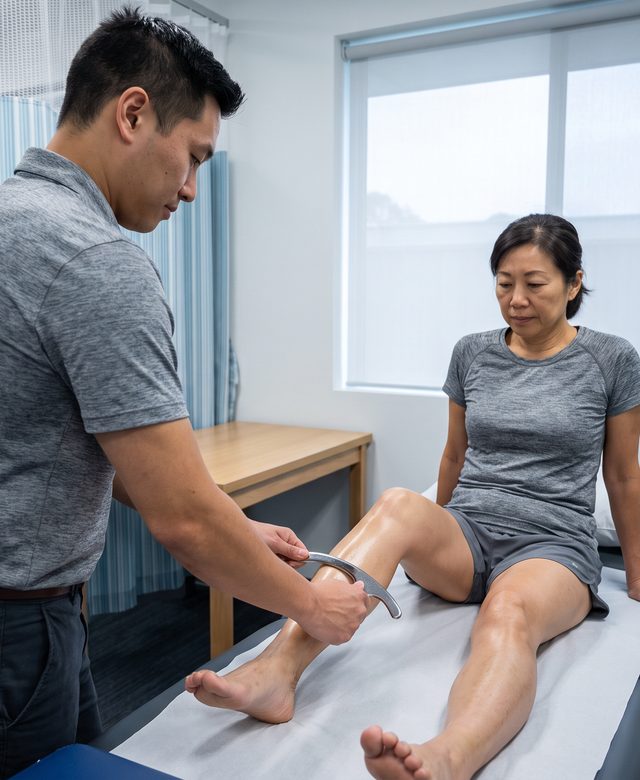
ASTYM is scheduled as part of a regular visit. Your Doctor of Physical Therapy locates the restricted tissue by feel, then works the resin instrument firmly over the area, targeting the specific scarring or fibrosis the evaluation identified. Most patients feel firm pressure and localized discomfort during treatment, and it’s common to see redness or light bruising afterward as the tissue responds.
The same visit typically continues into mobility or strength work while the tissue is primed to move, because the point of ASTYM is to create the conditions for that work to actually take hold, not to be the whole plan on its own.
Who this is for, and who it isn’t.
ASTYM tends to fit patients whose evaluation turns up chronic, fibrotic, or degenerative tissue, the tendon that’s been cranky for months, not weeks, that hasn’t responded to stretching, foam rolling, or manual therapy alone. It’s most useful as an accelerant inside an existing plan, not as a first appointment on its own.
If you’ve already tried the general stuff and a specific area just won’t loosen or heal, that’s worth raising at your evaluation.
It’s not appropriate for patients with active infection, open wounds, or certain bleeding disorders and blood-thinning medications near the target area, which your doctor screens for before ever picking up an instrument.
Good fit
- Chronic, fibrotic, or degenerative tissue that hasn’t responded to stretching or manual therapy alone
- Part of an existing physical therapy plan, not a first appointment
- One tool among several, not a substitute for the rest of the plan
- Willing to raise it at your evaluation if you’ve already tried other approaches
Not the right fit
- Active infection or open wounds near the target area
- Certain bleeding disorders or blood-thinning medications (screened at evaluation)
- Acute injuries better addressed by other tools first
Physical Therapy ⟶
The evaluation and plan it’s built to serve.
02Shockwave Therapy ⟶
Another tool for the same stubborn tissue, worked from a different angle.
It’s a tool inside the plan, never a standalone treatment.
“My elbow had been cranky for over a year. A few weeks of ASTYM paired with the loading program did more than a year of stretching on my own ever did.”Demo quote, pending client swap
Questions, answered plainly.
They’re in the same family. All three use a specialized instrument, not the hands alone, to find and treat restricted soft tissue. ASTYM uses its own resin instruments and a specific treatment protocol, but the goal across all of them is the same: locate the fibrotic or scarred tissue and stimulate the body to remodel it.
Most patients feel pressure and some discomfort over the specific restricted area, more than a light massage but not sharp pain. It’s common to see redness or light bruising afterward as the tissue responds. Most people describe post-treatment soreness as similar to a hard workout.
Here, no. ASTYM is scheduled inside an existing physical therapy plan, following a cause-first evaluation that confirms the tissue you’re dealing with will actually respond to it. It works best paired with the loading and movement work that keeps the tissue from re-restricting.
Chronic, fibrotic tissue doesn’t remodel in one visit. Most courses of care run about once or twice a week for several weeks, with your Doctor of Physical Therapy tracking how the tissue responds and adjusting from there. Some people notice a change in mobility within the first few sessions; degenerative tendon tissue usually takes longer.
Start with the evaluation that finds the restriction.
Put it in writing.
Five short questions. A real person calls you back, usually within two business hours, with times that fit your week.
The people who end up filling this out are rarely in the worst pain of their life. They’re just done working around it, done picking the errand that doesn’t require the stairs. If that’s the stage you’re at, this is the part where you stop researching and start.
Consider it filed.
A real person will call you back, usually within two business hours, with appointment times that fit your week. Keep your phone nearby.
Can’t wait? Call (801) 508-4784 ⟶Two clinics in Tooele. Both easy to park.
Two locations in town, both with parking by the door. Same team, same one-on-one care. Come see either one before you commit, if you like.
Two clinics · Reach Physical Therapy and Performance
Lodestone Way ⟶West 60 South ⟶Directions open in Google Maps